Patients no longer just call the clinic on a referral. They search, compare reviews, look at services, and decide whether to even try to book. If your digital front desk leaks, you do not lose visibility — you lose revenue. Here is the system we build to close it, end to end.
Quick takeaways
- The problem isn’t “no website.” It’s a broken digital front desk — search visibility, online trust, booking, follow-up, reminders and analytics that don’t talk to each other.
- 60% of patients read online reviews before choosing a clinic. 27% of practices say no-shows got worse in 2025. The leak is at the front desk, not the exam room.
- The fix is a connected system, not another standalone app — website + booking + CRM + reminders + AI assistant + reviews + analytics, all under one clinic identity.
- Triage first, automation second. Online booking without rules will overwhelm staff. Build the gates, then open the doors.
- This article walks through the working Doctor Growth & Appointment Automation System we ship for clinics — with screenshots from a live prototype.
The real problem doctors are facing
Walk into almost any small or mid-size clinic today and you will see the same picture. A receptionist is on a call, a WhatsApp group is buzzing on her phone, a paper register sits open, a Google Sheet is on the screen. Patients call to book, walk in, message on Instagram, fill a form on the website, and forget half of their appointments. Each one of those touchpoints is a silo. Each silo leaks revenue.
Modern patients do not behave like they did ten years ago. They search a specialty, read 4–5 reviews, glance at a clinic’s website, look for a “Book” button, and either trust you in 30 seconds or move on to the next listing. That short window is the whole game.
- 60% of patients look online for healthcare practice reviews before choosing a doctor.
- 27% of medical practices reported no-show rates increased in 2025.
- 11% improvement in outpatient hospital attendance from appointment reminders, in a 2026 meta-analysis.
The honest read: patient acquisition is now a software problem, not a marketing problem. The clinics that grow are not the ones with the loudest ads — they are the ones whose digital front desk does not drop the ball between the first search and the first visit.
“Doctors do not need just an appointment form. They need a controlled digital front desk — with rules, triage, categories, staff review and human handoff.”
The five leaks at the digital front desk
When we audit clinic operations for our customers at Smile Web Tech, we look for five recurring leaks. Almost every clinic has at least three of them.
Leak A · Patients search online before they trust you
The shift from referral-only to research-first is well documented. Tebra’s 2025 healthcare marketing data shows that 60% of patients look online for healthcare practice reviews, 45% say positive reviews are very or extremely important in their decision, and 48% still rely on word-of-mouth. Trust is now split between referral and digital proof — and digital proof is the half most clinics neglect.
What we usually find:
- No specialty pages or doctor profile page
- A weak Google Business Profile
- No appointment CTA above the fold
- No structured local SEO or schema markup
- No system to actually request reviews from happy patients
Leak B · Manual appointment booking
Phone calls, walk-ins, WhatsApp, paper registers — each is fine in isolation, but together they become a tangle of missed calls, double bookings, wrong slot times, no patient history attached, and no reminder. A 2025 Frontiers in Digital Health study notes that online appointment scheduling gives patients flexibility and time savings, and that SMS reminders are linked with lower no-show risk in clinical settings.
Leak C · No-shows directly damage revenue
No-shows are not just an annoyance. They waste a doctor’s most expensive resource — clinical time — and leave slots empty that someone else would have filled. 27% of medical practices reported no-show rates rose in 2025 per MGMA, and the practices that held the line credited consistent communication, digital reminders, automated calls and occasional live outreach. A 2026 systematic review found appointment reminders improved attendance by 11% overall, with both SMS and phone reminders helping.
Leak D · Admin overload & scattered systems
Doctors and clinic teams are already at capacity. The AMA’s 2026 update reports 41.9% of physicians had at least one symptom of burnout in 2025, with ineffective EHRs, inadequate staffing and excessive admin tasks among the top stressors.5 Adding more dashboards is the wrong answer. The right answer is fewer disconnected tools.
Leak E · Online booking without triage is its own problem
This one is important and most vendors miss it. UK GP groups warned in 2025 that all-day online booking can overwhelm an already strained practice if digital requests are not safely triaged — urgent and non-urgent get treated the same, and staff workload actually goes up.
Why this matters for you
Slapping a free booking plugin on a website is not a digital front desk. It is a faster way to overwhelm your staff. The system has to gate the right requests to the right people, with rules you control.
The leak map in one table
| Problem | What it looks like | What we ship to fix it |
|---|---|---|
| Poor online visibility | Doesn’t rank for “doctor near me” or specialty searches | Local SEO site, GBP optimization, doctor & service pages |
| Weak online trust | Few reviews, no doctor bio, no proof of expertise | Review request automation, education content, trust UI |
| Missed calls | Receptionist can’t answer every call | Online booking, missed-call lead capture, WhatsApp follow-up |
| Manual scheduling | Notebooks, WhatsApp threads, spreadsheets | Appointment system with calendar sync & rules |
| No-shows | Patients forget or book casually | SMS / WhatsApp / email reminders + reschedule link |
| Poor follow-up | Inquiries ask once and disappear | CRM pipeline for new-patient inquiries |
| No analytics | Doctor doesn’t know what works | Owner dashboard with source tracking |
| Compliance risk | Patient data on personal WhatsApp | Consent forms, role access, audit log, safe messaging |
| Staff overload | Reception repeats same answers daily | AI assistant for FAQs & intake — with human review |
Our solution: the Doctor Growth & Appointment Automation System
We do not sell another standalone tool. We build a connected Digital Front Desk for the clinic — one identity, one patient record, one set of rules, every channel feeding into it. It is a single system with seven modules:
- AI-ready clinic website — discovery and trust
- Online appointment booking — with categories, rules and waitlist
- Patient inquiry CRM — every lead becomes a tracked record
- WhatsApp / SMS / email reminder automation — to crush no-shows
- AI clinic assistant with guardrails — admin, never clinical
- Review & reputation automation — ethical, opt-in
- Clinic owner analytics dashboard — every step measured
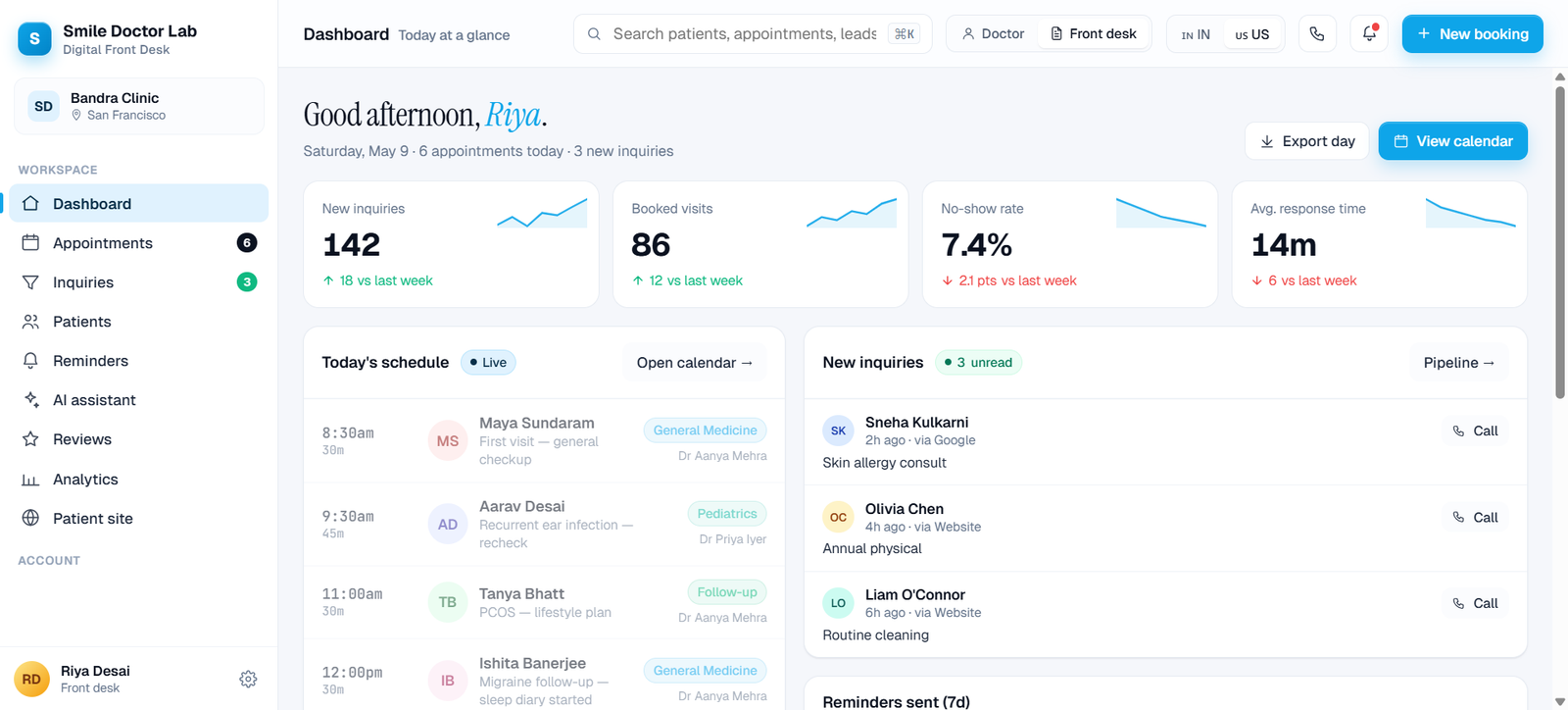
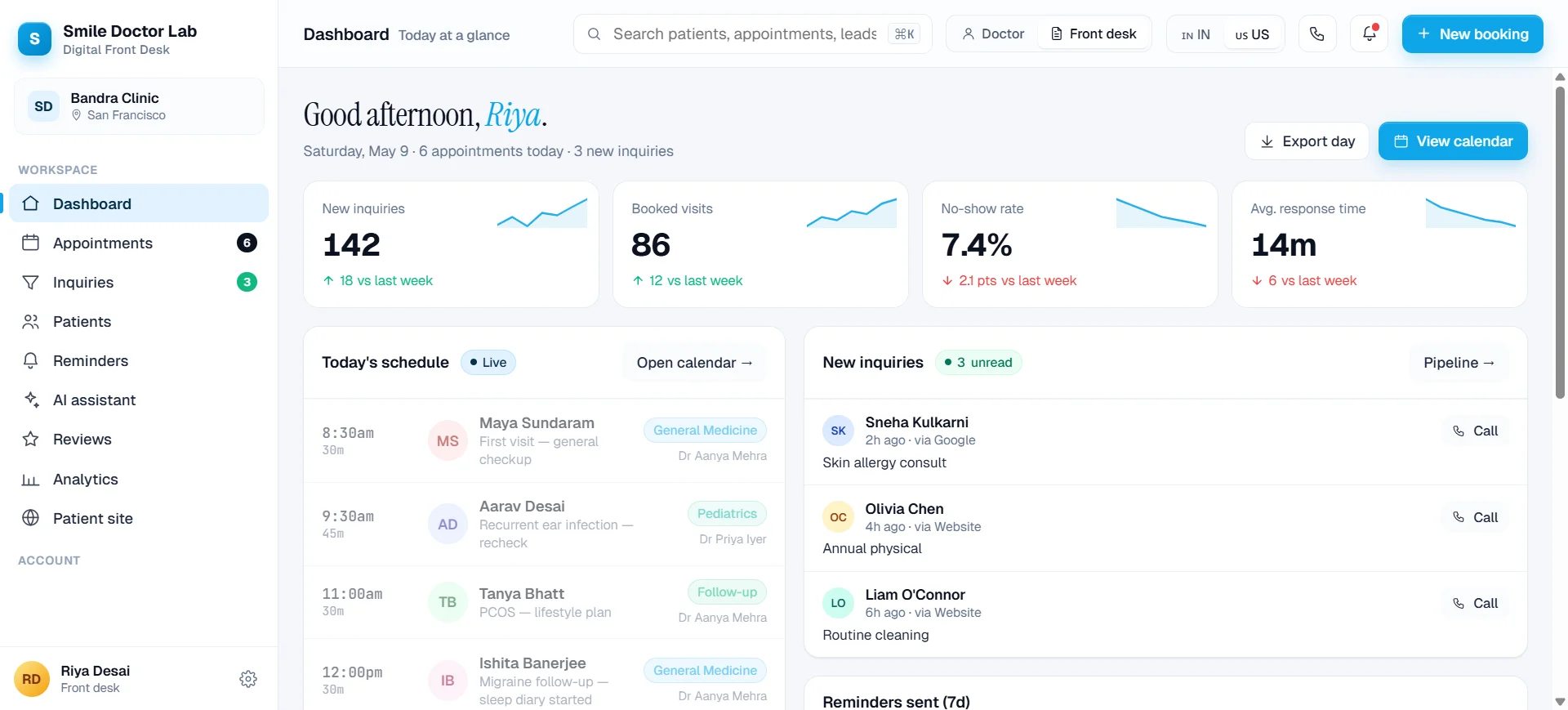
The image at the top of this article is from a live prototype we built for a multi-specialty clinic in Mumbai. The next section walks through every module. Every screenshot you see below is the actual working software — drag an appointment, it reschedules; toggle a reminder, it fires.
Module-by-module walkthrough
Module 01 · Appointments

A calendar that respects how a clinic actually runs.
Day, week and month views. Drag any visit to reschedule — the patient gets a new confirmation and reminder automatically. Color-coded by specialty, filterable by doctor, with a live “now” line. Empty slots show a waitlist option so a cancellation never costs you the slot.
- Service-type booking (consult, follow-up, teleconsult)
- New vs. returning patient flow
- Calendar sync (Google / Outlook)
- Reschedule & cancel link in every confirmation
- Waiting list for last-minute cancellations
Module 02 · Patient inquiry CRM
Every inquiry becomes a tracked record. Nothing falls into a WhatsApp.

The leads board is the heart of patient acquisition. Inquiries from Google, your website, Instagram, WhatsApp Business and referrals all land here as cards. Drag them across stages — new → contacted → booked → visited → no-show → follow-up. Source is tracked so you finally know which channel earns its money.
- Lead source tracking (Google, ads, IG, referral, walk-in)
- Auto-reminders for uncontacted leads after N hours
- Staff notes & assignment
- Daily summary email for the clinic owner
- Privacy-aware — internal only, never on personal phones
Module 03 · Patients & records
One patient, one timeline.

Searchable patient list with quick facts, visit history, attached documents, allergies, and contact preferences. Click a name to see every interaction the clinic has had with them — the first inquiry, all visits, all reminders sent, the next appointment. The kind of context that turns a 4-minute consult into a great one.
- Linked to inquiries, appointments and reminders
- Document upload (reports, prescriptions, scans)
- Tags & segments (new, returning, follow-up, teleconsult)
- Role-based access — only the right staff see the right data
Module 04 · Reminder automation
The single biggest revenue lever in a clinic.

Booking confirmation, 24-hour reminder, 2-hour reminder, post-visit follow-up, missed-appointment rebooking. Every message has Confirm / Reschedule / Cancel buttons so patients respond in one tap. Channel switches between WhatsApp, SMS and email per patient preference and region.
- WhatsApp Business API · SMS · Email — one builder
- One-tap confirm / reschedule / cancel
- Templates respect HIPAA / DPDP rules (no PHI in subject lines)
- A/B test wording to lower no-show rate over time
- Auto-escalation — if no confirm by 2h, route to staff
Why this is the #1 fix
The 2026 meta-analysis showed an 11% lift in attendance from reminders alone.3 For a clinic doing 1,200 visits a month at ₹600 per consult, that is roughly ₹79,000 / month recovered — for a feature that runs in the background.
Module 05 · AI clinic assistant
Built with guardrails. It answers where, when, what to bring — never what’s wrong with me.

Patients ask the same questions every day: clinic hours, location, fees, what to bring, whether you treat X. The AI assistant handles those 24/7. The moment a query looks clinical or urgent, it stops talking and routes to a human. We configure exactly what is on and what is off, per clinic policy.
Safe use
- Hours, location, services, availability
- Fees range, insurance, documents to bring
- Pre-visit instructions; rebooking
Off-limits
- Diagnosis or prescription advice
- Emergency triage without a human
- Storing or replying with sensitive PHI
NCBI’s 2024 review on healthcare chatbots is clear — they are useful for access and admin tasks, but evidence for clinical effectiveness is still developing.7 AI should help with access, not replace the doctor. We build it that way on purpose.
Module 06 · Reviews & reputation
Earn trust ethically. The way regulators expect.

After a visit, we send a polite review request to patients who consented to follow-up. Happy patients are gently directed to public review channels. Unhappy patients are routed privately to the clinic so the team can respond before it becomes a public 1-star. Templates and tone are kept inside what the National Medical Commission’s professional conduct regulations consider appropriate for Indian doctors — patient education, honest information, no exaggerated claims.8
- Opt-in review request after visit
- Internal-first routing for low ratings
- Single inbox for Google, Practo, Justdial reviews
- Staff response templates & rating trend chart
Module 07 · Owner analytics
The clinic, finally measurable.

One dashboard, one source of truth. New inquiries, booked visits, no-show rate, average response time, lead source mix, top searched services, follow-up pending. The clinic owner sees the funnel — lead → booking → visit — and exactly which step is leaking.
- 30-day, 90-day, year-over-year trend charts
- Source attribution (Google, IG, referral, ads)
- Doctor-level performance & utilization
- Exportable monthly report (PDF / Sheets)
Module 08 · Public clinic website
The front door — fast, trustworthy, conversion-shaped.

A mobile-first, schema-marked, SEO-structured website with doctor profiles, specialty & service pages, education content, FAQs, and a booking widget that triages before it confirms. The widget asks the right pre-questions so urgent and routine visits don’t end up in the same queue.
- Schema markup for doctor, clinic, FAQ, services
- Doctor profile pages — credentials, photo, bio
- Specialty & service pages — one per offering
- Patient education blog (Google E-E-A-T)
- Booking widget with triage rules
India DPDP & HIPAA: what we make safe by default
Most “clinic apps” treat compliance as someone else’s problem. We build it into the schema and the workflows. Two regulatory frames matter most for our customers:
India
Digital Personal Data Protection Act, 2023 + DPDP Rules (2025)
India notified the DPDP Rules in November 2025, giving full effect to the DPDP Act with a framework for responsible processing of digital personal data. We design with explicit consent, purpose limitation, role-based access, audit logs, and data residency in mind from day one.
United States
HIPAA — appointment reminders & safeguards
HHS guidance allows appointment reminders without separate authorization when treated as part of treatment, but electronic communication still needs reasonable administrative, physical and technical safeguards. We respect that line — no PHI in subject lines, encrypted transport, clinic-controlled retention.
For Indian doctors specifically, marketing content also has to respect the National Medical Commission’s Registered Medical Practitioner Professional Conduct Regulations.8 So our website templates and review request flows lean on patient education, accurate clinic information, and access — never exaggerated claims or unethical promotion.
Before vs. after: what changes in 90 days
This is the picture we see when a clinic moves from a stitched-together front desk to the integrated system. Numbers below are typical for a 4–6 doctor multi-specialty practice in our customer base. Yours will vary, but the directions are consistent.
Before · scattered tools
- 30–40% of website traffic leaves without contact
- 20% of phone inquiries never get a callback
- 15–20% no-show rate
- Owner has no idea which channel earns money
- Staff manually copying data between WhatsApp, register and Sheets
- Patient data on personal phones (compliance risk)
After · Digital Front Desk
- Every visitor either books or becomes a tracked lead
- 0 inquiries lost — auto-escalation kicks in
- No-show rate down ~30–40% from automated reminders3
- Source attribution shows what to invest in next
- One system; staff learn one workflow
- Consent-based, role-scoped, audit-logged data
How we build it — typical 6 to 8 week timeline
This is custom software, not a template. But we have done it enough times that the path is well-worn. Here is what a typical engagement looks like:
- Week 1 · Discovery & audit. We sit with you and your front desk staff for a half day, audit the current funnel, decide which channels to plug in (WhatsApp Business, Google Business, Practo, etc.) and lock the booking rules.
- Week 2 · Brand & site build. Doctor profile pages, specialty pages, schema markup, education content seeding. Local SEO baseline.
- Week 3–4 · Core system. Appointments, CRM, patient records, reminders, role-based access.
- Week 5 · AI assistant & analytics. Configured to your clinic policy, tested on real questions, dashboard wired to live data.
- Week 6 · Reviews, payments, integrations. Google reviews, payment gateway, calendar sync, optional Practo / Apollo integrations.
- Week 7–8 · Staff training & soft launch. One in-person session, written SOPs, two weeks of hand-holding while we tune the reminder cadence and triage rules.
After launch we run a monthly review — what is working, what to tune, what to add next. The system is yours; we just make sure it keeps earning for you.
Frequently asked questions
How is this different from buying a ready-made clinic management software?
Off-the-shelf clinic software is typically built around billing or EHR. It rarely solves the patient acquisition side — website, SEO, lead capture, source tracking, reminder automation, AI assistant. We build the front-of-funnel and connect it cleanly to whatever EHR or billing tool you already use, instead of replacing it.
How much does it cost?
Custom — because the modules and integrations vary. A small single-doctor clinic with website + booking + reminders typically lands in a smaller bracket than a 6-doctor multi-specialty with WhatsApp Business, payment gateway, AI assistant and full analytics. We always start with a free discovery call and a written scope before any commitment.
Will the AI assistant give my patients medical advice?
No. We configure it explicitly to handle administrative questions only — clinic hours, location, services, availability, fees, what to bring, rebooking. The moment a query looks clinical or urgent, it routes to a human and posts a note in the CRM. This is non-negotiable for us.
Is patient data safe? Where is it stored?
Yes. We follow DPDP and HIPAA-aligned practices: explicit consent, role-based access, audit log, encrypted transport and at-rest storage. For Indian clinics we keep data in-region. For US clinics we offer HIPAA-aligned cloud configuration. We sign a Data Processing Agreement / BAA where required.
What if my staff is not very tech-savvy?
That’s normal. The system is designed to be one workflow, not seven. We do an in-person training session, leave you a written SOP, and stay on hand-holding for the first two weeks. After that, most clinics tell us reception spends less time on the phone and more time on patients.
Can it integrate with my existing EHR / Practo / Apollo / Tata 1mg?
Yes for most. We integrate with anything that exposes a public API — Practo, Apollo, Tata 1mg, Google Business, WhatsApp Business API, Razorpay, Stripe, Google & Outlook calendars, and most major EHRs. If something doesn’t have an API we build a manual sync workflow that doesn’t break.
How fast does it pay back?
Most clinics see the no-show drop in the first month — that single lever often pays for the system. The acquisition lift from website + SEO + review automation typically compounds over 3–6 months. We share clear metrics in the owner dashboard so the ROI is visible, not assumed.
Can I see a working version before we start?
Yes. We will walk you through a live prototype on a Zoom call (every screenshot in this article is from one). Bring your front desk lead — the questions they ask are usually the most useful.
Free discovery call
Show me where my clinic is leaking — then build the system that fixes it.
30 minutes on Zoom. We audit your current digital front desk, identify the 2–3 leaks costing you the most, and walk you through the live prototype. No slide deck, no commitment.